WE BUY SURPLUS ELECTRICAL WIRE ACROSS CENTRAL KANSAS
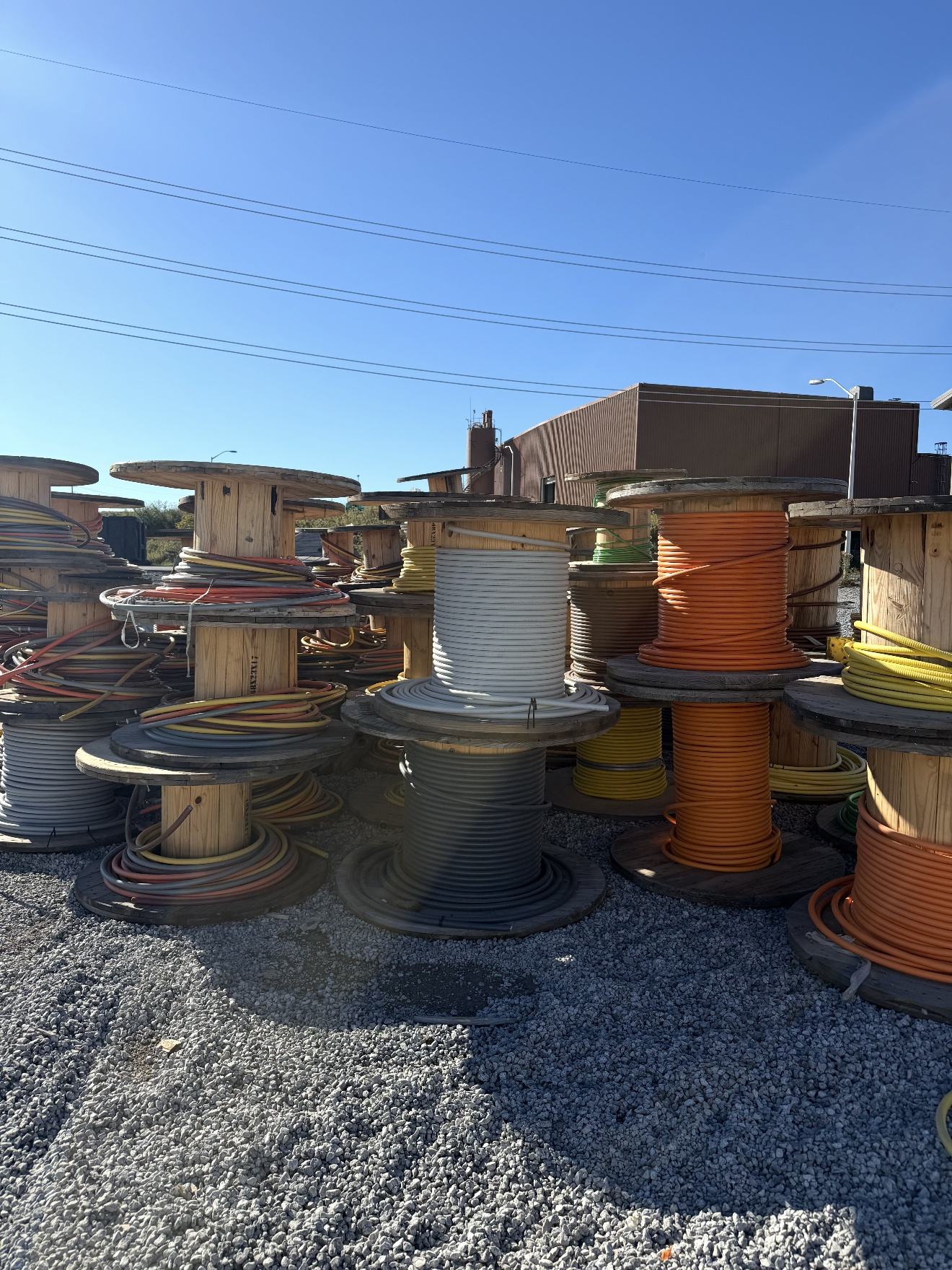
Along I-70 and down I-135, elevators, food plants and oilfield shops keep cable in stock long after the job that ordered it. We buy those reels and collect them from the site.
Central Kansas is a corridor before it is anything else. Salina sits where I-70 crosses I-135, with Kansas City about three hours east and Hays about two hours west, and almost every town in between earns its living from grain, food, manufacturing or oilfield service. All four use cable in quantity and all four store what they do not use.
The surplus tends to be practical rather than exotic: THHN and XHHW in the common sizes, tray cable for plant runs, direct-burial cable for well sites and service entrances, and the occasional reel of medium-voltage cable from a co-op or substation job. We price it from the tag and arrange collection from the yard.
Salina, where the two interstates meet
Salina is the region's clearing house. Distribution houses serve a radius of a hundred miles from the interstate junction, contractors run crews west along I-70 and south down I-135, and the industrial parks on the edge of town hold plants that were built when rail freight was cheaper than it is now.
That combination produces steady surplus. A distributor discontinues a color or a size and the reel goes to the back rack. A contractor finishes a school or a hospital wing and brings 600 feet of 4/0 building wire back to the shop. A plant swaps out a feeder during a shutdown and stacks the old cable by the dumpster because nobody has decided what else to do with it.
Salina is also where loads from smaller towns get consolidated. If you have reels in Ellsworth, Lindsborg and Salina, they can be quoted together and collected on one run, provided the photographs show what is at each address.
Grain, food plants and the cable that runs them
Grain handling is everywhere in this region, and it is electrically demanding. Elevators run large motors on long feeders, with dust, vibration and seasonal overload as constant conditions. When a leg is rebuilt or a dryer is replaced, the feeder and control cable that comes out is heavy, often aluminum, and usually too short for the next job.
Food processing adds washdown to the list. Plants that hose down equipment need cable and glands rated for wet locations, and they replace runs more often than a dry factory would. That produces a regular trickle of tray cable, SOOW cord and motor lead cable, some of it only a few years old.
Both industries keep spares, and spares go stale. A plant holding a reel of 500 MCM for a motor that was replaced two years ago is holding dead capital, and the store room is the first place to look when a maintenance budget is being trimmed.
- Aluminium feeder and 500 MCM to 1000 MCM runs from elevator and mill work.
- Tray cable and VFD cable from process lines and washdown areas.
- Motor lead and SOOW cord from pump and conveyor replacements.
- Control and instrumentation cable from plant automation upgrades.
Oil and gas service from Great Bend to Russell
Oilfield service follows the older fields. Great Bend, Russell, Hays and the smaller towns between them host shops that maintain pumping units, rebuild engines and wire tank batteries. The cable in those shops is bought in bulk and cut to length, so the offcuts accumulate: welding cable, heavy flexible cord, direct-burial feeder for well sites and control cable for automated wells.
Much of it has been outside for years. Sun damages a jacket slowly, and a cable that has spent five summers on a truck bed will be chalky and stiff even if the copper inside is sound. That is normal here, and it is priced rather than refused. What matters is whether the conductor is intact and whether the jacket still keeps water out.
Service companies also hold cable they inherited. When a shop changes hands or a partner retires, the back room turns out to contain reels nobody has looked at since the last boom. Those loads are worth a photograph before they are worth a skip.
Rural electric cooperatives and very long feeders
Cooperatives serve most of the ground between the towns here, and their work generates a particular class of surplus: 15 kV and 25 kV cable, URD and USE-2 for new services, and the short ends that come off a rebuild. A co-op lineman does not keep a 200-foot length of 15 kV cable on the truck if the next job needs 2,000 feet.
Storm work adds to it. Ice and wind take down spans across this region every few years, and the rebuild leaves cut lengths that are sound but too short for a primary run. Some of that material is reused for services; some of it sits in the yard.
Voltage class matters more than length for this material. Photograph the tag, which will state the kV rating and the conductor size, and note whether the cable is concentric neutral or tape shielded. A reel of 15 kV cable photographed without its tag is hard to price with any confidence.
- 15 kV and 25 kV primary cable left after a line rebuild.
- URD and USE-2 service lengths from new connections.
- Bare copper grounding from substation and yard work.
The corridor town by town
Distances here are honest driving distances, not marketing. The table gives a rough sense of where the region's surplus sits and how far it is from Salina, which is where most loads are consolidated before collection. Times assume a normal drive and a trailer, not a fast car.
Where a town has no forklift and no dock, say so early. A grain elevator with a scale and a loader is easier to collect from than a shop on a gravel lot, and the difference is worth knowing before a vehicle is dispatched.
| Town | County | From Salina | Usual surplus |
|---|---|---|---|
| Hays | Ellis | About 2 hours west | Plant maintenance, oilfield service stock |
| Great Bend | Barton | About 1 hour 15 southwest | Elevator feeder, food plant tray cable |
| McPherson | McPherson | About 40 minutes south | Manufacturing spares, control cable |
| Russell | Russell | About 1 hour west | Oilfield cord, welding cable, URD |
| Concordia | Cloud | About 1 hour 40 northeast | Grain handling, rail-side warehouses |
Send photographs of the tags and the footage to saleselectricalbuyers@gmail.com, or call +1 (614) 715-3047. Say which town the reels are in, how they can be loaded and whether a forklift is on site.
Local pages
Cities in Central Kansas
Straight answers
QUESTIONS FROM CENTRAL KANSAS
Do you travel west of Hays for a single reel?
A single reel at the far edge of the region is a thin job, but it is still worth asking about, particularly if it is medium voltage or a large conductor. Combining it with other material at the same address or in the same town makes it more practical.
Can you price aluminum feeder from a grain elevator?
Yes. Aluminium is bought alongside copper, and large aluminum feeder is common in elevator and mill work. The tag or jacket print should show the size and the insulation type, and the conductor condition matters more than the color of the jacket.
What do you need to know about direct-burial cable from well sites?
The size, the insulation type and whether the cable was in conduit or buried directly. URD and USE-2 that has been in the ground is dirty but often sound. Photograph a cut end so the conductor and the jacket thickness are visible.
Will you quote a co-op's short lengths of 15 kV cable?
Yes, with the caveat that the tag decides it. kV rating, conductor size and shielding type all affect the price. Lengths under a few hundred feet are bought, but they are priced as lengths rather than as reels.
Request a quote
TELL US WHAT YOU HAVE
Send the details and photos of the reels. A tag photo and a jacket photo answer most of our questions, so you do not have to measure anything twice.
- Wire and cable only: no transformers, switchgear, breakers, MCCs, generators or machinery.
- Full reels, partial reels, spools, coils and boxed stock all welcome.
- Statewide Kansas pickup arranged after we agree on the load.
- Prefer to talk it through? Call +1 (614) 715-3047.
SELL YOUR SURPLUS WIRE IN CENTRAL KANSAS
Send the tag photos and we will price the lot, partial reels included.