MEDIUM AND HIGH VOLTAGE CABLE, 5 kV THROUGH 69 kV
On medium voltage the reel tag is the whole story: voltage class, insulation level, conductor size, shield type and length.
Medium-voltage cable is the most valuable wire in a utility or industrial yard and the easiest to misdescribe. A 15 kV reel at the 100 percent insulation level and one at 133 percent look identical until the tag is read, and the difference runs through the whole valuation.
We buy 5 kV, 8 kV, 15 kV, 25 kV, 35 kV and 69 kV cable across Kansas, EPR and XLPE, concentric neutral and tape shield, jacketed and unjacketed, on full and part reels. Three photographs cover it: the tag, the reel face and a cut end. Voltage class and insulation level are the first two questions.
The Layers That Make MV Cable
Medium-voltage cable is built in layers, and every layer has a job. A stranded copper or aluminum conductor sits at the center. A semiconducting conductor shield follows it, then the insulation, EPR or XLPE, then a semiconducting insulation shield, then the metallic shield of concentric neutral wires or copper tape, then the jacket.
The two semiconducting layers are what separate medium-voltage cable from building wire. They smooth the electric field at the conductor surface and at the insulation surface, which is why a nick in the insulation shield matters more than a scuff on the jacket. A cable with damaged insulation shield is a cable with a problem.
- 5 kV, 8 kV and 15 kV for distribution feeders, pad-mounted transformers and industrial mains.
- 25 kV and 35 kV for utility distribution and larger industrial services.
- 46 kV and 69 kV for subtransmission, usually single conductor on heavy reels.
- EPR insulation: flexible, tolerant of moisture, more forgiving to splice.
- XLPE and tree-retardant XLPE: higher dielectric strength, stiffer, common in URD.
Insulation Wall Thickness and What It Tells You
Insulation is specified by wall thickness and by insulation level. A 15 kV cable at the 100 percent level carries 175 mils of insulation; at the 133 percent level it carries 220 mils. The thicker wall is chosen for circuits exposed to higher switching surges or impulse levels, and it costs more to make.
That is why the class and the level are asked for before anything else. A 15 kV 500 MCM cable at 175 mils and one at 220 mils look alike on a reel and are not the same product. The tag normally prints both, and the wall can be measured at a cut end when the tag is gone.
| Voltage class | 100% wall | 133% wall | Typical conductor | Typical reel | Typical use |
|---|---|---|---|---|---|
| 5 kV | 90 mil | 115 mil | 2 AWG-500 MCM | 500-5,000 ft | Plant distribution, small substations |
| 8 kV | 115 mil | 140 mil | 2 AWG-500 MCM | 500-5,000 ft | Industrial feeders, older plant systems |
| 15 kV | 175 mil | 220 mil | 1/0-1000 MCM | 1,000-5,000 ft | Utility distribution, pad-mount loops |
| 25 kV | 260 mil | 320 mil | 1/0-1000 MCM | 1,000-5,000 ft | Utility distribution, longer runs |
| 35 kV | 345 mil | 420 mil | 1/0-1000 MCM | 1,000-5,000 ft | Subtransmission, large industrial |
Concentric Neutral, Tape Shield and Jacket
Concentric neutral is the common shield for utility distribution cable: copper wires applied helically over the insulation shield and sized as a fraction of the phase conductor. A one-third neutral is standard on many 15 kV circuits. A full neutral carries more fault current and contains more copper.
Tape shield is thin copper tape applied with overlapping turns, used where fault current is lower and a compact cable matters, such as substation and industrial work. Some constructions use a longitudinally corrugated copper shield with drain wires. The jacket over the shield, usually PVC or polyethylene, is what keeps water out of the shield.
- Concentric neutral in one-sixth, one-third or full neutral.
- Tape shield with overlap, for lower fault current duty.
- Longitudinally corrugated shield with drain wires for substation work.
- Jacketed and unjacketed constructions, which change where the cable may be installed.
- Direct-burial URD MV: aluminum conductor, concentric neutral, jacketed.
Reels, Weight and Handling
Medium-voltage cable is heavy, and the reel is part of the handling problem. A 60 inch wooden reel carrying several thousand feet of 15 kV cable is a machine lift rather than a two-person lift, and a reel must never be dropped on its flange. A dropped reel can crush the inner layers and leave cable that tests badly.
Reels are lagged for transport and should stay lagged until installation. Store them upright on firm ground, with the drum clear of the dirt where possible. The minimum bend radius for shielded cable is generous, on the order of a dozen times the outside diameter, and a reel stored on its side for a season will have taken a set.
- 48, 60, 72 and 96 inch flanges, with 60 inch the common utility size.
- Wooden reels are returnable in some supply chains, so keep any deposit tag.
- Note lagging condition and whether the reel has been dropped or stored on its side.
- Cable ends should be sealed against moisture, since water travels down a stranded conductor.
- Say what can lift the reel: a forklift with the reach, or a crane for the largest sizes.
Photograph and Note
Photograph the tag, the reel face and one cut end. The tag states voltage class, conductor size, insulation level, shield type and length. The cut end shows the layers in order, which confirms what the tag claims and reveals the wall thickness.
Cable is what we buy, and only cable. Transformers, switchgear, breakers, motor control centers, generators, chillers and machinery are outside the offer, including the cans and switches at the end of the cable. Underground distribution is covered with URD and USE-2, conductors under aluminum wire, and the quote form takes the reel details.
- The reel tag, flat and readable, with length and voltage class.
- The full reel, so flange diameter and remaining cable are visible.
- A cut end, showing conductor, insulation wall and shield.
- Any jacket damage, exposed shield or flattened cable on the outer layer.
- Splices or terminations still attached, and whether kits are on the reel.
Send the tag, the reel face and a cut end. Medium voltage is priced from those three photographs and the length, not from the color of the jacket. Reel size matters as well, since it decides how the cable leaves your yard.
Related buying pages
Other wire families we buy
Aluminum Wire
AA-8000 building wire, aluminum SER and URD, priced on its own terms.
Open pageBuilding Wire
Copper and aluminum branch, feeder and service wire, boxed coils or full reels.
Open pageTHHN, THWN and XHHW
The everyday conduit wire, including THWN-2 and XHHW-2 in wet and dry locations.
Open page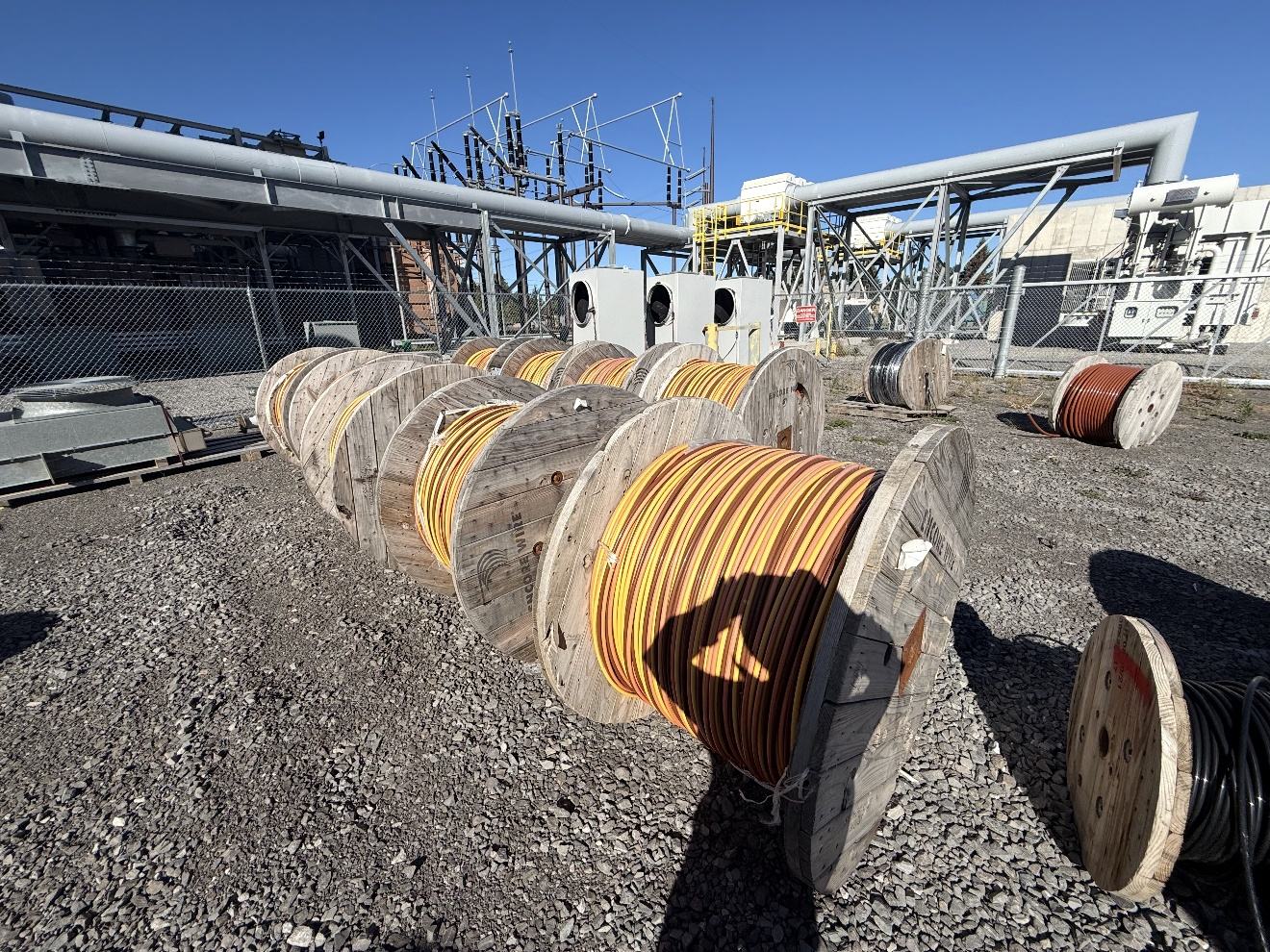
Straight answers
QUESTIONS ABOUT THIS CABLE
What does 100 percent insulation level mean?
It is the impulse withstand level the cable is built to, expressed as a percentage of the basic insulation level. A 133 percent cable has a thicker wall for circuits exposed to higher surges. The tag states the level, and the wall thickness at a cut end confirms it.
Do you buy 15 kV cable that has been in service?
Yes, if it was removed carefully and the jacket and shield are intact. Say how long it was in service and whether it was tested before removal. Cable with exposed shield or crushed insulation is not saleable as cable.
Can you take a reel with a splice on it?
Yes, and the splice should be photographed. A splice left on a reel changes the length that can be used as one piece, so the cable is priced as two lengths rather than as one continuous run.
What about terminations and elbows found with the reel?
Terminations, elbows and splice kits found with cable are noted with the lot. The offer is for wire and cable, so those items are described rather than valued as equipment, which we do not buy.
How is 69 kV cable handled?
69 kV and above is usually single conductor, larger copper or aluminum, on steel or heavy wooden reels, and it needs equipment to move. Older paper-insulated lead-covered cable still appears in utility yards and is bought as cable where the sheath is intact.
Request a quote
TELL US WHAT YOU HAVE
Send the details and photos of the reels. A tag photo and a jacket photo answer most of our questions, so you do not have to measure anything twice.
- Wire and cable only: no transformers, switchgear, breakers, MCCs, generators or machinery.
- Full reels, partial reels, spools, coils and boxed stock all welcome.
- Statewide Kansas pickup arranged after we agree on the load.
- Prefer to talk it through? Call +1 (614) 715-3047.
SELL YOUR SURPLUS WIRE IN MEDIUM AND HIGH VOLTAGE CABLE
Send the tag photos and we will price the lot, partial reels included.