WE BUY SURPLUS ELECTRICAL WIRE IN WESTERN KANSAS
Out here the nearest supply house can be fifty miles away, so everyone keeps spare cable. When that spare cable stops being spare, we buy it and collect it on site.
Western Kansas is beef, irrigation, gas and wind, spread across counties larger than some eastern states. Each of those industries runs heavy electrical equipment in places where a service call costs a day, so spares are kept on site: a reel of feeder, a coil of direct-burial cable, a spare length of 15 kV for the co-op line. When the equipment changes, the spare stays.
That is the surplus we buy, from Garden City along US-50 and US-54 to Dodge City and Liberal and north toward Colby. Photographs of the reel tags start the quote. Collection is arranged from the plant, the farm yard or the substation, and the offer covers wire and cable only.
Beef, feedyards and the plants that run them
The beef industry dominates this region's electrical load. Processing plants at Garden City and Dodge City run refrigeration, conveyors, rendering and wastewater treatment on a schedule that never stops, and the maintenance crews inside them rewire sections during planned outages rather than between shifts.
That work produces cable in quantity: large feeder from motor control rooms, tray cable along process lines, flexible cord at washdown points and control cable for the instrumentation that keeps temperatures and flows in range. A single project can leave several part reels, each one tagged and each one too short for the next job on the list.
The feedyards that supply the plants run lighter equipment but more of it, spread over acres: augers, mixers, pumps, lighting and the small services that feed scale houses and offices. Their cable is bought in coils, used hard, and often stored in a shed that is not weathertight.
- Tray cable and motor feeder from processing plant outages.
- SOOW cord and welding cable from maintenance shops.
- Control and instrumentation cable from refrigeration and wastewater work.
- Direct-burial service cable from feedyard and yard lighting.
Pivots, wells and 480-volt runs across a section
Irrigation is the region's quiet electrical system. A center pivot needs a motor at the pivot point, a control panel, and a buried run back to the meter, often a quarter mile from the road. Multiply that across a farm and the amount of underground cable in the ground is considerable.
When a pivot is replaced, a well is re-drilled or a field is taken out of production, that cable comes up. Some of it is re-used; most of it sits in a coil by the shop because the farmer knows it cost real money and cannot bring himself to scrap it. That is exactly the material worth pricing.
Aluminium direct-burial cable is common for these runs because of the distance and the cost. It is bought, and the conductor condition is what decides the price. A coil that has been lying in the open for a decade with the jacket chewed by sunlight is a different proposition from one that came out of the ground last month.
Wind farms and the substations between them
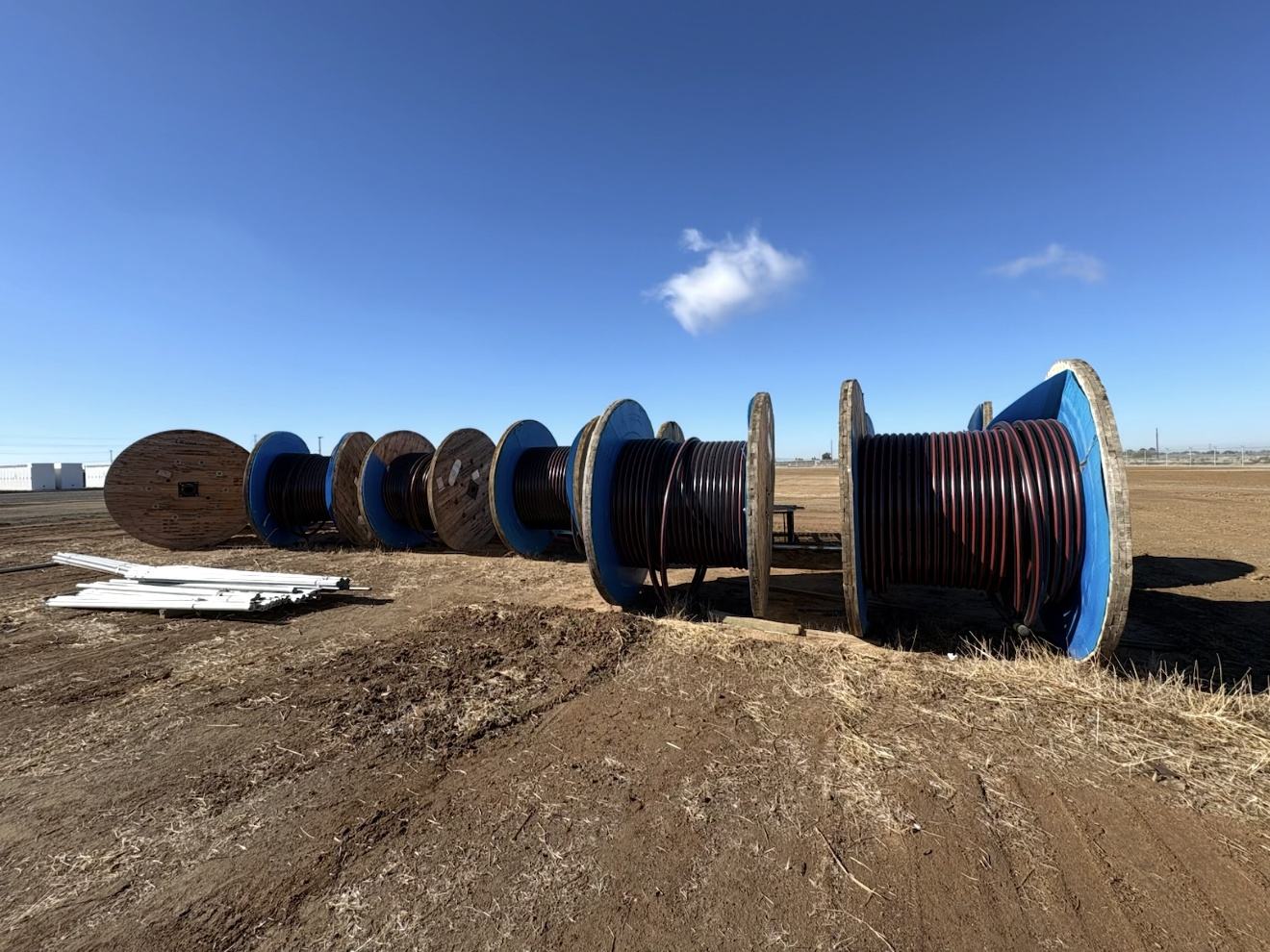
Wind development has added a new layer of cable to the region. Collection systems run medium-voltage cable from each turbine back to a substation, and construction of a project leaves cut lengths, spare reels and drum ends that were ordered for contingencies and never installed.
The material is specific: 35 kV and 25 kV cable, concentric neutral, XLPE or EPR insulation, and the terminations and splices that go with it. A spare reel left after commissioning is worth a proper quote rather than a scrap price, and the tag usually carries everything needed to price it.
Substation work also produces short lengths of heavier cable and grounding conductor. Copper grounding is bought, including bare conductor that has been in the ground. If a project has finished and the drum ends are still in the laydown yard, photograph them before the yard is cleared.
- Spare reels of 35 kV collection cable after commissioning.
- Drum ends from collection and feeder runs.
- Bare copper grounding from yard and grid work.
Gas, old fields and the trucks that serve them
The Hugoton field and the smaller pools around it have been producing for generations, and the service companies that look after those wells are still working out of small yards in the county seats. Their trucks carry welding cable, booster cable, cord and the control wiring that keeps automated wells reporting.
This is not clean cable. It has been on a truck bed in the sun, coiled in the dirt, spliced more than once. It is still bought, at a price that reflects the condition. Photograph the worst section rather than the best, and say how many coils there are and roughly what length each one holds.
Old fields also mean abandoned infrastructure. When a battery is decommissioned, the cable that fed it is pulled and piled. That material needs sorting into what is still usable and what is not, and the sorting is part of the quote rather than something we assume.
Town to town on the high plains
Distances here decide whether a collection makes sense. The table below gives approximate road distances between the towns where surplus most often sits, including the long run south to Liberal and the two-lane stretches north of Garden City. They are ordinary driving distances on highway, not promises about scheduling.
Because the region is large, a load is usually gathered at one address before a vehicle is sent. If the reels are spread between a plant and a farm thirty miles out, move them to the plant first and tell us that the yard has a loader. It is the simplest way to keep a collection to one stop.
| Town | County | Main highway | Distance to the next town |
|---|---|---|---|
| Garden City | Finney | US-50 and US-83 | Dodge City, about 50 miles east |
| Dodge City | Ford | US-50 and US-283 | Liberal, about 85 miles south |
| Liberal | Seward | US-54 and US-83 | Garden City, about 70 miles northwest |
| Ulysses | Grant | US-160 | Garden City, about 55 miles northeast |
| Hugoton | Stevens | US-56 | Liberal, about 40 miles southeast |
| Colby | Thomas | I-70 and US-24 | Hays, about 100 miles southeast |
Send photographs of the tags and the footage to saleselectricalbuyers@gmail.com, or call +1 (614) 715-3047. Tell us the county, what equipment can lift a reel, and whether the cable has been stored inside.
Local pages
Cities in Western Kansas
Straight answers
QUESTIONS FROM WESTERN KANSAS
Do you collect from a farm or a feedyard with no dock?
Yes, and it is common here. Tell us what equipment is on site, whether a loader or telehandler can lift a reel, and whether a truck can turn around. A flat dirt yard with a tractor is workable if we know about it in advance.
Is sun-damaged cable from an irrigated field still bought?
Usually at a reduced price. Ultraviolet exposure makes a jacket chalky and eventually brittle, and the conductor underneath may still be sound. Photograph the jacket where it has been exposed and a freshly cut end so both can be judged.
Can you price a spare reel of 35 kV cable left after a wind project?
That is one of the better inquiries in this region. Photograph the tag, which should give the kV rating, conductor size and insulation type. State whether the reel is full and whether it has been stored indoors or in a laydown yard.
What is the smallest load worth collecting this far out?
It depends on the material more than the weight. A single reel of large conductor or medium-voltage cable can justify the trip where a dozen coils of number 12 would not. Give us the details and we will say plainly whether it works.
Do you take the transformers and meters that came off the poles?
No. Transformers, meters, switchgear and breakers sit outside the offer, which is wire and cable only. Pole-mounted cable and service drops are in scope; the hardware they connected to is not.
Request a quote
TELL US WHAT YOU HAVE
Send the details and photos of the reels. A tag photo and a jacket photo answer most of our questions, so you do not have to measure anything twice.
- Wire and cable only: no transformers, switchgear, breakers, MCCs, generators or machinery.
- Full reels, partial reels, spools, coils and boxed stock all welcome.
- Statewide Kansas pickup arranged after we agree on the load.
- Prefer to talk it through? Call +1 (614) 715-3047.
SELL YOUR SURPLUS WIRE IN WESTERN KANSAS
Send the tag photos and we will price the lot, partial reels included.