WE BUY WIRE FROM CONSTRUCTION AND DEMOLITION CONTRACTORS
One crew pulls feeders out of a building coming down; another closes out a job with four reels nobody opened. Both are cable with no next job.
A demolition crew pulls feeders out of a building that is coming down. A general contractor closes out a project with four reels that were never opened. Both are the same problem: cable on the ground, no next job for it, and a debris box that is priced by weight.
We buy wire and cable from construction and demolition contractors in Kansas. New surplus, pulled salvage and partial reels, priced on type, size and footage rather than on scale weight. Pickup is arranged from the site or from your shop, and the cable travels in the coils and reels it is already sitting in.
Two kinds of wire leave a site
New wire and salvage are priced differently because they are different materials. New surplus is unused, still banded, often still tagged, and it sells on identity. Salvage has been pulled, coiled, dragged and stored outdoors, and it sells on condition plus metal content. Keep the two apart in the photographs, because a mixed pile takes longer to price and prices worse.
The distinction matters most with copper. Clean, full-gauge copper wire holds value whether or not anyone still needs that size. Cable cut into three-foot pieces loses the footage that made it useful in the first place.
- New surplus: unopened reels, banded coils, factory cartons
- Pulled salvage: feeders and branch circuits removed in one piece
- Demolition cable: cut at both ends and coiled on site
- Partial reels and spool ends from a job that just finished
What is worth pulling in a teardown
In a building coming down, the cable worth the labor is the heavy copper: service entrance conductors, riser cable between floors, feeders from the service to distribution, and large branch circuits. Romex and MC pulled out of walls is usually too short and too tangled to quote well.
Old cloth-and-rubber wiring from a pre-war building is a different material and is generally not what gets priced here. Modern THHN, THWN and XHHW is. If the building was rewired in the last forty years, that is where the value sits.
Where the wire is decides what it is likely to be.
| Location | What it usually is |
|---|---|
| Service entrance | SER, SEU or large conductors in conduit |
| Riser between floors | Copper feeder, often 4/0 and larger |
| Panel to panel | THHN or XHHW feeders |
| Branch circuits | MC, AC or NM cable, mostly short lengths |
| Site and parking lighting | URD, USE-2 or direct-burial feeder |
Construction: cancelled phases and leftover pulls
On the construction side, surplus comes from change. A phase is deferred, an alternate is value-engineered out, a tenant finish is redesigned after the rough-in package is bought. Wire ordered for the original scope arrives, sits in a connex, and outlasts the people who ordered it.
Over-ordered pull lengths are the ordinary case. Crews add waste to the takeoff, the last pull comes in short of the reel, and a few hundred feet stay on it. Multiply that across a school, a clinic or a warehouse shell and the rack behind the trailer fills up.
Before the truck comes
Documentation on a demolition site is thin, so the photographs carry the weight. Shoot the jacket legend where it is still readable, the reel tag if one survives, and the coil with something in frame for scale. Note the length as an estimate and say that it is one. A rough number is more useful than a confident wrong one.
Pulled cable ships coiled and tied, on a pallet or in a crate, or back on the reel it came off. Loading at a teardown is usually a machine and a flatbed; at a shop it is a dock. Two details decide the plan: whether the ground is firm enough for a loaded truck in wet weather, and whether the debris box is sitting in the way.
The offer is wire and cable only. Structural steel, conduit, panelboards, transformers, switchgear, breakers, generators and machinery are not part of it, and mixed scrap is a different trade. Sorting cable out of the debris is the one job worth doing before the photographs. The quote form takes the photos, the footage and the site address.
- Photos of the jacket print, the reel tag and the coil
- Approximate footage per coil, and how it was measured
- Whether the cable is new or pulled
- Site access: gate width, ground conditions, overhead lines
- A contact on site who can sign the ticket
Separate new from pulled, tie the coils, photograph the print and the tag. Send the site address and say what can reach the pile. The price follows the material, and the pickup follows your schedule.
Common categories
Wire these operations usually hold
Aluminum Wire
AA-8000 building wire, aluminum SER and URD, priced on its own terms.
Open pageBuilding Wire
Copper and aluminum branch, feeder and service wire, boxed coils or full reels.
Open pageTHHN, THWN and XHHW
The everyday conduit wire, including THWN-2 and XHHW-2 in wet and dry locations.
Open page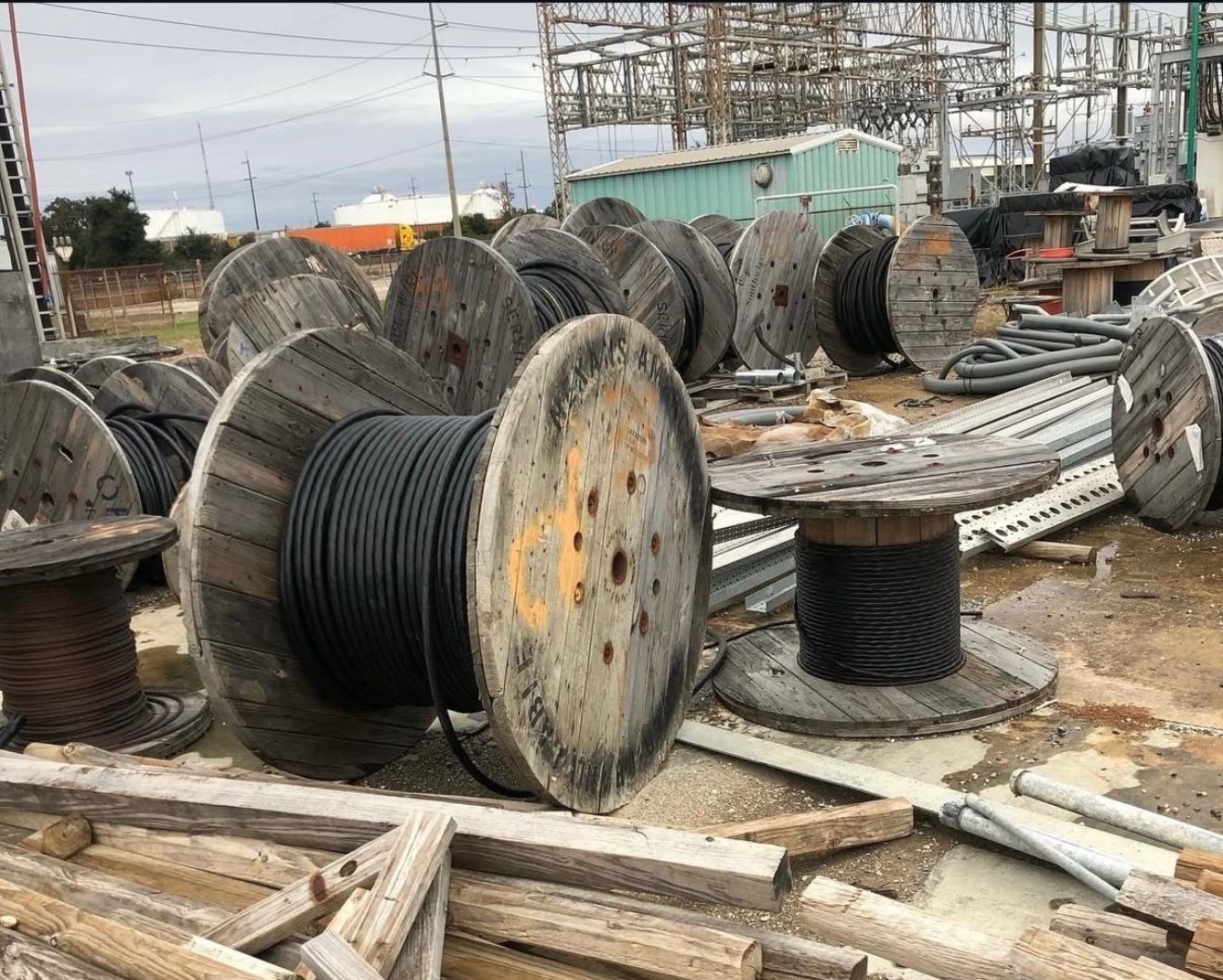
Straight answers
QUESTIONS FROM THIS SIDE OF THE LOAD
Is demolition cable with cut ends worth anything?
Yes, at salvage pricing rather than new-surplus pricing. Value comes from the metal and from whether the length is still usable. Coils of fifty feet and up are easier to place than a tangle of short pieces. Keep coils tied and labelled with an approximate length.
How much does the jacket condition matter on old cable?
A readable legend identifies type, size and voltage, which is most of the pricing. Frayed jacket at the cut ends is normal after a pull. Cable with insulation damaged along its length is judged on copper content alone, and that has to be visible in a photograph.
Can you collect from a site with no power or lighting?
Yes, if the cable is staged where a truck can reach it in daylight. Say what the ground is like and whether a loaded truck can turn around. On a teardown the material often gets moved twice, so agreeing the staging spot early saves a wasted trip.
Request a quote
TELL US WHAT YOU HAVE
Send the details and photos of the reels. A tag photo and a jacket photo answer most of our questions, so you do not have to measure anything twice.
- Wire and cable only: no transformers, switchgear, breakers, MCCs, generators or machinery.
- Full reels, partial reels, spools, coils and boxed stock all welcome.
- Statewide Kansas pickup arranged after we agree on the load.
- Prefer to talk it through? Call +1 (614) 715-3047.
SELL YOUR SURPLUS WIRE IN CONSTRUCTION AND DEMOLITION CONTRACTORS
Send the tag photos and we will price the lot, partial reels included.