THHN, THWN-2 AND XHHW-2: WHAT THE JACKET ACTUALLY RATES
One reel can read THHN, THWN and THWN-2 in the same line of print. The suffix decides where the wire may be installed and which column of the ampacity table applies.
THHN is the most common wire in Kansas conduit, and the most commonly misread. Three letters on a jacket can mean 90 degrees dry only, or 90 degrees wet and dry, and the difference decides whether a reel can go underground, into a wet location or only into a dry raceway.
We buy THHN, THWN, THWN-2, XHHW and XHHW-2 from #14 through 1000 MCM, in copper and aluminum, on full reels, part spools and cut lengths. The quote turns on the print on the insulation, so the print is the first thing we ask for. Nothing else identifies the wire as reliably.
Two Materials: Thermoplastic and Thermoset
THHN, THWN and THWN-2 are thermoplastic. A PVC insulation is extruded over the conductor and a thin nylon jacket is extruded over the PVC. XHHW and XHHW-2 are thermoset: cross-linked polyethylene, with no nylon jacket at all. The distinction is not marketing language. Thermoplastic softens as it heats and can deform under fault current; thermoset chars and holds its shape.
In practice the thermoplastic family pulls more easily, because the nylon jacket is slick and abrasion resistant, which is why it dominates conduit work and why most building wire in a Kansas shop is THHN rather than XHHW. The thermoset family is chosen where the conductor will sit wet, where deformation under heat matters, or where a specification has named XHHW-2 and means it.
- THHN: 90°C dry and damp, 600 volts, nylon jacketed, not a wet-location conductor on its own.
- THWN: 75°C dry and wet, 600 volts, nylon jacketed.
- THWN-2: 90°C dry and wet, 600 volts, the version most stocked today.
- XHHW: 90°C dry, 75°C wet, 600 volts, cross-linked polyethylene.
- XHHW-2: 90°C dry and wet, 600 volts, also built in 1 kV and 2 kV constructions.
- TFFN: fixture wire, 18 and 16 AWG, 90°C, 600 volts, never a branch-circuit conductor.
Dry, Wet and the Meaning of the Dash Two
The dash two is the wet-location 90 degree rating. A conductor marked THWN-2 carries its 90 degree ampacity in a wet location; one marked THWN carries 75 degree ampacity there; one marked only THHN is not permitted in a wet location at all. Dual and triple markings are common, so the whole legend has to be read.
Most THHN sold today is printed THHN or THWN-2 on one line, which is how the same reel can be accepted on one job and refused on another by an inspector reading only the first three letters. The print governs. If the jacket is faded past reading, the wire is unidentified, and unidentified wire is priced lower.
| Type | Material | Dry and wet rating | Voltage | Sizes | Packaging |
|---|---|---|---|---|---|
| THHN | Thermoplastic, nylon jacket | 90°C dry, not for wet locations | 600 V | 14 AWG-1000 MCM | 500-2,500 ft spools |
| THWN | Thermoplastic, nylon jacket | 75°C dry, 75°C wet | 600 V | 14 AWG-500 MCM | 500-2,500 ft spools |
| THWN-2 | Thermoplastic, nylon jacket | 90°C dry, 90°C wet | 600 V | 14 AWG-1000 MCM | 500-2,500 ft spools |
| XHHW | Thermoset XLPE | 90°C dry, 75°C wet | 600 V | 14 AWG-1000 MCM | 500-5,000 ft reels |
| XHHW-2 | Thermoset XLPE | 90°C dry, 90°C wet | 600 V, 1 kV, 2 kV | 14 AWG-1000 MCM | 500-5,000 ft reels |
| TFFN | Thermoplastic, nylon jacket | 90°C dry, not for wet locations | 600 V | 18-16 AWG | 500-2,500 ft spools |
| MTW | Thermoplastic, oil resistant | 90°C dry, 60°C wet | 600 V | 18-2 AWG | 500-1,000 ft spools |
90 Degrees With Conditions
A 90 degree rating is a ceiling, not a permit. Conductors may be sized from the 90 degree column only where the terminations, the equipment and the conductor are all rated 90 degrees. Breakers and lugs are usually 75 degree, so the finished circuit lands on the 75 degree column. The 90 degree ampacity remains useful as the starting point for ambient correction and conduit-fill derating.
This is where most counter arguments begin. A 1/0 copper THWN-2 carries 170 amperes in the 90 degree column and 150 in the 75 degree column, and behind a 75 degree breaker the second figure is the one that counts. Small conductors are capped again at 15, 20 and 30 amperes for 14, 12 and 10 AWG.
| Size | 75°C | 90°C | Usual circuit |
|---|---|---|---|
| 12 AWG | 25 | 30 | 20 A branch circuit |
| 10 AWG | 35 | 40 | 30 A circuit |
| 8 AWG | 50 | 55 | 40 to 50 A feeder |
| 6 AWG | 65 | 75 | 60 A feeder |
| 1/0 AWG | 150 | 170 | 120 to 150 A feeder |
| 4/0 AWG | 230 | 260 | 200 A service |
| 350 MCM | 310 | 350 | 300 A service |
Oil, Gasoline, Sunlight and Where Each Type Belongs
The nylon jacket is what gives THHN and THWN-2 their gasoline and oil resistance, shown on the legend as an oil-resistant or gasoline and oil resistant marking. XHHW-2 relies on the cross-linked polyethylene instead, and whether a given reel carries an oil-resistant marking depends on the manufacturer. Read the print rather than assuming it.
Sunlight resistance is a separate marking and a separate question. A conductor installed exposed outdoors needs a sunlight-resistant legend, which most modern THWN-2 and XHHW-2 reels carry and older stock often does not. Direct burial needs a direct-burial rating, which single-conductor building wire generally does not have.
- THHN and THWN-2 for conduit indoors, and for wet conduit where the dash two is printed.
- XHHW-2 for feeders, wet locations, exterior runs and anything a specification names.
- MTW for machine tools, control panels and cabinet interiors, at 90°C dry and 60°C wet.
- TFFN inside luminaires and fixture whips, where Article 402 applies rather than Article 310.
- Green THHN or XHHW as an equipment grounding conductor, sized from the overcurrent device.
What to Photograph, and What We Do Not Buy
A photograph of the legend is worth more than a photograph of the box. The box says 12 AWG THHN. The legend says THHN or THWN-2, 600 volts, 90 degrees, sunlight resistant, and that is the sentence a quote is built from.
We buy wire and cable and nothing that switches it. Transformers, switchgear, breakers, motor control centers, generators, chillers and machinery are outside the offer. If the wire is armored or bundled for a tray rather than loose in a conduit, MC, AC and tray cable is the closer page, and the quote form takes either.
- The full legend along one conductor, unrolled flat for 20 inches or more.
- The spool face and the manufacturer label, with footage if it is printed there.
- The spool or reel size, since a 500-foot spool and a 2,500-foot reel are different lots.
- The conductor end, showing solid or stranded, and the strand count on 8 AWG and larger.
- The storage conditions, and whether the wire has been pulled and returned.
Send the legend, the spool face and the footage. The type is printed on the wire, not in the part number somebody wrote on a box six years ago. A photograph of the print outranks a description every time.
Related buying pages
Other wire families we buy
MC, AC and Tray Cable
Armored and corrugated cable, tray cable, VFD cable and PLTC, cut lengths included.
Open pageSER, SEU, URD and USE-2
Service entrance and direct-burial cable, aluminum or copper, full or partial.
Open pageBare Copper and Grounding
Bare and insulated grounding conductors, bonding jumpers and clean copper wire.
Open page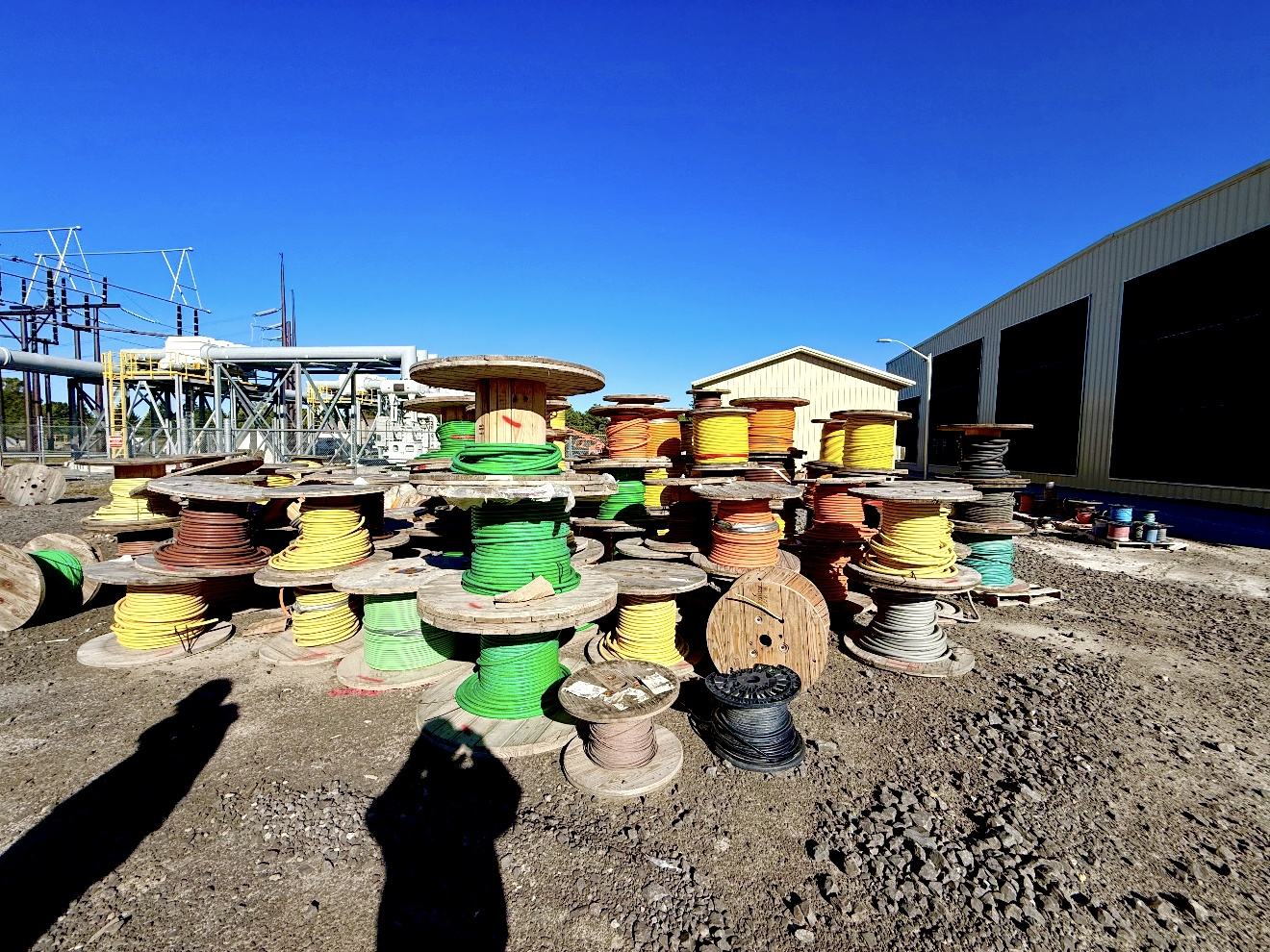
Straight answers
QUESTIONS ABOUT THIS CABLE
Is THHN the same as THWN?
Often they arrive on the same reel. Most THHN made now is dual marked THHN or THWN-2, so one conductor carries both ratings. If the legend shows only THHN, it is a dry-location conductor and it is priced that way.
Why is XHHW-2 specified instead of THHN?
Usually for wet locations, for feeders where the engineer wants a thermoset insulation, or because a specification names it. XHHW-2 holds 90 degrees in wet conditions and has no nylon jacket to scuff through in a difficult pull.
Can the 90 degree ampacity be used for a breaker?
Only where the terminations and the equipment are rated 90 degrees, which is uncommon outside special equipment. In normal work the 90 degree column is used to derate, and the result is then capped at the 75 degree value of the terminations.
Do you buy faded or unmarked wire?
Yes, but it is priced as unidentified. The conductor can be measured and the insulation judged, yet a rating that cannot be read cannot be claimed by the next user, so the offer reflects the lower use.
Do you buy TFFN and MTW?
Yes, on spools and part spools. TFFN is fixture wire and MTW is machine tool wire. Both are bought as their own types rather than as THHN, because the ratings, the listings and the buyers differ.
Request a quote
TELL US WHAT YOU HAVE
Send the details and photos of the reels. A tag photo and a jacket photo answer most of our questions, so you do not have to measure anything twice.
- Wire and cable only: no transformers, switchgear, breakers, MCCs, generators or machinery.
- Full reels, partial reels, spools, coils and boxed stock all welcome.
- Statewide Kansas pickup arranged after we agree on the load.
- Prefer to talk it through? Call +1 (614) 715-3047.
SELL YOUR SURPLUS WIRE IN THHN, THWN AND XHHW
Send the tag photos and we will price the lot, partial reels included.