WELDING CABLE AND PORTABLE CORD, #6 TO 4/0 AND LARGER
Welding cable and portable cord are bought on stranding and jacket condition. A stiff, ozone-cracked length of 2/0 is worth less than a flexible one of the same size.
Welding cable and portable cord are the most abused wire in any shop. They get dragged, coiled wet, run over and left in the sun, and the jacket takes the damage before the copper does. That history is what a buyer is pricing. A ten-year-old lead can be sound or finished, and the difference is visible.
We buy welding cable from 6 AWG to 4/0 and larger, SOOW and SJOOW cord, cord sets, festoon and stage cable across Kansas. The print on the jacket and an honest photograph of the worst spot will settle most of the value. Coils, part coils and single leads are all quotable.
Welding Cable Is Its Own Article
Welding cable is a single-conductor cable built for the secondary side of an arc welder: fine-stranded copper, a rubber jacket and a 600 volt rating, in sizes from 6 AWG through 4/0 and larger. Article 630 treats it separately, and so do the ampacity tables, because a welder lead is sized by duty cycle rather than by the continuous rating used for building wire.
Stranding is the number that matters. Class K cable is built from 30 AWG strands and Class M from 34 AWG, which is why a 2/0 welding lead feels like rope and a 2/0 building conductor feels like pipe. The finer the strand, the more the cable costs to make, and the more it is worth as surplus if the jacket has survived.
- Sizes 6, 4, 2, 1, 1/0, 2/0, 3/0 and 4/0, with 250 to 500 MCM in heavier leads.
- 600 volts, with a jacket temperature rating printed by the manufacturer.
- Neoprene or EPDM jacket, oil resistant, flame retardant and sunlight resistant.
- Class K stranding at 30 AWG and Class M at 34 AWG; both flex, M more so.
- Black, red, blue, green and orange jackets, with red and black the common pair.
Reading a Portable Cord Letter Code
Portable cord is named letter by letter, and each letter answers a question. S is a 600 volt hard-service cord; SJ is the 300 volt junior version with smaller conductors. The first O is an oil-resistant jacket, the second O is oil-resistant insulation, and W means the cord is rated for wet locations and outdoor use.
A T replaces the rubber with thermoplastic, which is cheaper and stiffer. A P means the conductors are parallel rather than twisted. That is why SOOW, SJOOW, STW and SJTW are not interchangeable: two letters change the voltage, the temperature and whether the cord may be used outdoors at all.
| Type | Voltage | Jacket | Common sizes | Packaging | Typical use |
|---|---|---|---|---|---|
| SOOW | 600 V | Thermoset rubber, oil and weather resistant | 18-2 AWG, 2-5 conductor | 250-1,000 ft coils | Heavy portable equipment, generators |
| SJOOW | 300 V | Thermoset rubber, oil and weather resistant | 18-10 AWG, 2-4 conductor | 250-500 ft coils | Small tools, pumps, temporary lighting |
| SOW | 600 V | Thermoset rubber, weather resistant | 18-2 AWG | 250-1,000 ft coils | Outdoor cord without oil exposure |
| SJTW | 300 V | Thermoplastic, weather resistant | 18-12 AWG | 250-1,000 ft coils | Light tools and extension cords |
| Welding cable | 600 V | Neoprene or EPDM | 6 AWG-4/0 | 250-500 ft reels | Welder secondary leads and work grounds |
| Festoon | 300-500 V | Rubber or polyurethane | 18-6 AWG, multi-conductor | 100-500 ft reels | Crane and hoist trolleys |
| Stage multicable | 600 V | Thermoset rubber | 12-10 AWG, 6 circuit | 150-500 ft coils | Entertainment power distribution |
Cord Sets, Festoon and Stage Cable
Cord sets are the finished articles: molded generator cords, range and dryer cords, RV cords, L5-30 and L14-30 assemblies, CS6364 and CS6365 stage connectors, and the 12/3 and 10/4 extension cords that get left on site. They are bought as cord and connector together, and the connector type is worth a photograph.
Festoon cable hangs in a loop from a crane or hoist trolley and flexes thousands of times a shift, so it is built flat or round with a high strand count and an abrasion-resistant jacket. Stage cable is the entertainment version of the same problem: 12/3 and 14/3 SOOW, six-circuit multicable and 19-pin assemblies, usually black and always coiled hard.
- Molded cord sets with plug and receptacle still attached.
- Generator and transfer-switch cords in 10/4 and 6/4.
- Stage multicable and 19-pin fan-out assemblies.
- Flat and round festoon cable with the support core intact.
- Bulk SOOW and SJOOW on 250 and 500 foot coils.
Jackets, Flexibility and What Wears Out
Jacket condition decides most of the value. Rubber jackets fail by ozone cracking, abrasion, cuts and heat, and a cable dragged across a shop floor for three years shows all four. A deep cut that reaches copper retires that section, and a lead with several such cuts is priced as shorter usable pieces.
Flexibility is the second test. Bend the cable: a lead that has stiffened has usually been overheated or has absorbed oil, and it will not lie flat in a feeder. Water wicked down the strands from an open end is the third problem, and it is the one a photograph cannot show.
Photograph and Note
Uncoil three feet and photograph the print, then photograph the jacket damage honestly. The print gives the type and the voltage, and on better cable it gives the stranding class. The jacket gives the condition, which is most of the price.
The offer stops at wire and cable. Transformers, switchgear, breakers, motor control centers, generators, chillers and machinery are outside it, and a welder itself counts as machinery. Tray-rated portable power cable belongs with MC and tray cable, plant maintenance stock is described under manufacturing and industrial, and the quote form starts either conversation.
- The print on the jacket, unrolled flat and legible.
- The cut end, showing strand fineness and whether the copper is bright or dark.
- Any cuts, cracks or flat spots, photographed close.
- The full coil, so length and coiling are visible.
- Cord sets with the connectors in frame, so the configuration can be identified.
Send the print, the cut end and an honest photograph of the worst place on the jacket. That is the whole valuation for this kind of cable. Length matters, but condition matters more.
Related buying pages
Other wire families we buy
Control, Instrumentation and Low Voltage
Shielded pairs, control and instrumentation cable, fire alarm, communication and data.
Open pageMedium and High Voltage Cable
5 kV through 69 kV and above, EPR or XLPE, concentric neutral or tape shield.
Open pageAluminum Wire
AA-8000 building wire, aluminum SER and URD, priced on its own terms.
Open page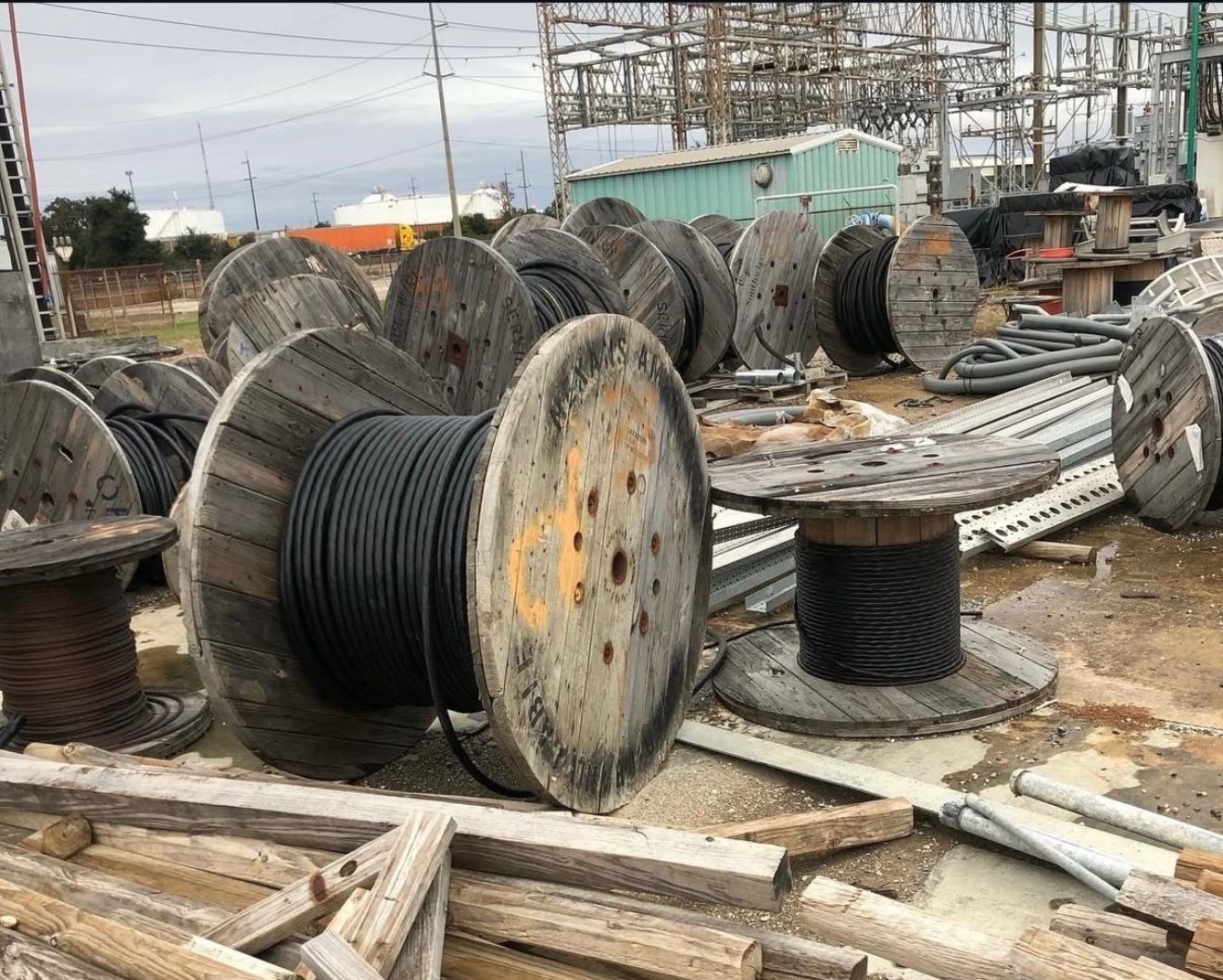
Straight answers
QUESTIONS ABOUT THIS CABLE
What is the difference between Class K and Class M welding cable?
Class K is made from 30 AWG strands, Class M from 34 AWG. Both are flexible and both are used for welder leads, with Class M finer and more costly. On a surplus lot the class usually matters less than jacket condition and length.
Do you buy welding cable with a damaged jacket?
Yes, at a reduced value, and the reduction is explained rather than hidden. A short section with one cut can be trimmed and used. A lead with damage every ten feet is worth little more than its copper.
Is SOOW the same as SJOOW?
No. SOOW is a 600 volt hard-service cord; SJOOW is the 300 volt junior version with smaller conductors and a smaller overall diameter. The voltage rating alone decides which jobs each can serve.
Do you take cord sets with molded ends?
Yes. Molded generator cords, range cords, RV cords and stage assemblies are bought as complete items. Photograph the connectors, because a molded L14-30 set and a plain length of 10/4 are valued differently.
Do you buy festoon cable?
Yes, flat and round, with or without the support core. Festoon is judged on jacket abrasion and on whether the copper is still bright, since a crane cable that has flexed for years can be sound or worn through at the trolley.
Request a quote
TELL US WHAT YOU HAVE
Send the details and photos of the reels. A tag photo and a jacket photo answer most of our questions, so you do not have to measure anything twice.
- Wire and cable only: no transformers, switchgear, breakers, MCCs, generators or machinery.
- Full reels, partial reels, spools, coils and boxed stock all welcome.
- Statewide Kansas pickup arranged after we agree on the load.
- Prefer to talk it through? Call +1 (614) 715-3047.
SELL YOUR SURPLUS WIRE IN WELDING CABLE AND SOOW
Send the tag photos and we will price the lot, partial reels included.